
Toda vez que você joga uma decisão difícil pra IA — quanto cobrar por algo, qual caminho seguir na carreira, lançar ou não lançar um projeto — você recebe uma resposta. Uma só. Que pode ser brilhante. Ou pode ter um buraco do tamanho de um caminhão e você nunca vai saber, porque só viu uma perspectiva.
É o problema mais silencioso do uso de IA hoje: a gente confunde resposta confiante com resposta certa. E quando o assunto é uma decisão real, com consequência real, isso vira roleta-russa com cara de sabedoria.
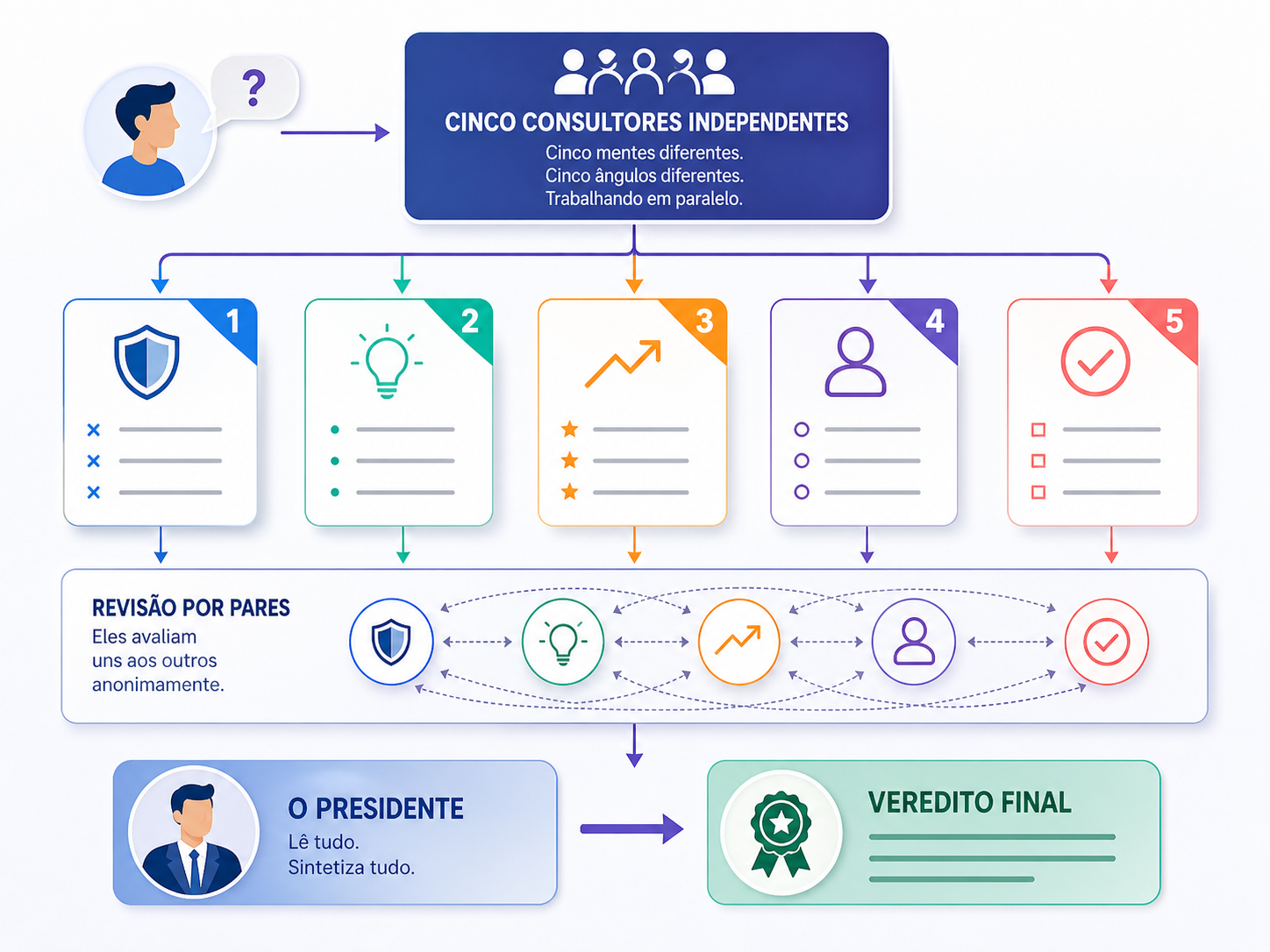
Cansei de ver isso acontecer — comigo, com leitores nossos, com gente próxima. Então preparei uma coisa especial pra quem acompanha o IATD: um “conselho de IAs” que você instala dentro do Claude (ou do Codex) uma vez e usa pra sempre. Você joga a sua dúvida e, em vez de pegar uma única opinião, cinco “conselheiros” diferentes analisam separadamente, revisam o trabalho um do outro, e um sexto agente — o Presidente — sintetiza tudo num veredito final.
De onde veio essa ideia
O método foi descrito pelo pesquisador Andrej Karpathy, um dos nomes mais respeitados em IA hoje (ex-cofundador da OpenAI, liderou o time de IA da Tesla). A intuição dele é simples: numa decisão importante, uma única perspectiva é frágil. Estilos de pensamento diferentes pegam coisas diferentes. A resposta que você precisa não é uma — é a síntese de várias opiniões independentes que se pressionaram entre si antes de chegar em você.
Karpathy montou um sistema onde a mesma pergunta é despachada pra vários modelos de IA, esses modelos revisam as respostas uns dos outros sem saber quem escreveu o quê (pra não puxar saco) e um “presidente” lê tudo e produz a resposta final.
O que peguei e adaptei pra você é uma skill — um arquivinho de texto com instruções — que traz toda essa metodologia pra dentro do Claude (ou do Codex) automaticamente. Você instala uma única vez. A partir daí, sempre que digitar frases-gatilho como “council this” ou “pressure-test this”, o conselho inteiro é montado em segundos. Sem precisar configurar nada toda vez.
Quem são os cinco conselheiros
Cada conselheiro pensa por um ângulo diferente. Não são personagens fofos: são estilos de raciocínio que naturalmente entram em conflito uns com os outros. É exatamente esse atrito que faz o método funcionar.
1. O Cético
Ele procura o que está errado. Onde a ideia falha. Qual é a pergunta que você está varrendo pra debaixo do tapete porque dá medo de olhar. Não é pessimista — é aquele amigo que te salva de um mau negócio fazendo a pergunta que você está evitando fazer.
2. O Pensador de Princípios
Esse ignora a pergunta superficial e vai direto pra “o que você está realmente tentando resolver?” Tira camada por camada de suposição até chegar na raiz. Às vezes a contribuição mais valiosa dele é dizer: “você está fazendo a pergunta errada“.
3. O Expansionista
Procura o lado positivo que ninguém está vendo. O que pode ser maior? Que oportunidade está escondida ali do lado? E se isso der mais certo do que você imagina? O Expansionista não se importa com risco — esse é trabalho do Cético. Ele quer entender o teto da coisa.
4. O Forasteiro
O conselheiro mais subestimado. Não tem contexto nenhum sobre você, sua área, sua história. Responde só pelo que está escrito ali na frente dele. Por que isso importa? Porque especialista cria ponto cego. Coisas óbvias pra você são confusas pra todo mundo. O Forasteiro pega isso na hora.
5. O Executor
Só liga pra uma coisa: isso pode ser feito de verdade? E qual o caminho mais rápido? Ignora teoria, estratégia, “big picture”. Olha cada ideia pela lente de “tá, ótimo, mas o que você faz segunda-feira de manhã?” Se a ideia é linda mas não tem primeiro passo claro, o Executor vai lá e expõe.
Por que esses cinco e não outros? Porque eles criam três tensões naturais: Cético contra Expansionista (risco contra potencial). Pensador de Princípios contra Executor (repensar tudo contra fazer agora). E o Forasteiro fica no meio mantendo todo mundo honesto, vendo o que olhos cansados não veem mais.
Como uma sessão funciona, do começo ao fim
Você joga a sua pergunta com a frase-gatilho. Por exemplo: “council this: estou em dúvida entre largar o emprego e empreender ou ficar mais um ano juntando reserva“.
O que acontece em seguida (sem você fazer mais nada):
- Os cinco conselheiros respondem em paralelo, cada um do seu ângulo, sem saber o que os outros estão pensando.
- As respostas são anonimizadas (viram “Resposta A”, “Resposta B”…) e enviadas pros mesmos cinco — agora como revisores. Cada um aponta qual resposta achou mais forte, qual tem o maior ponto cego, e o que todas deixaram passar.
- O Presidente lê tudo: as cinco respostas originais e as cinco revisões. E produz o veredito final num formato fixo: onde o conselho concorda, onde discorda de fato, quais foram os pontos cegos pegos só na revisão, qual a recomendação direta (sem “depende, vai do contexto”) e uma única coisa que você deve fazer primeiro.
- No fim, você recebe um relatório em HTML visual e um transcrito completo em Markdown. Os dois ficam salvos na sua pasta, pra você revisitar depois ou rodar o conselho de novo lá na frente, depois de mexer em alguma coisa.
Um exemplo concreto pra ficar bem claro
Imagina que você está pensando em lançar um curso online de R$ 997 sobre IA pra empreendedores não-técnicos. Joga isso pro conselho:
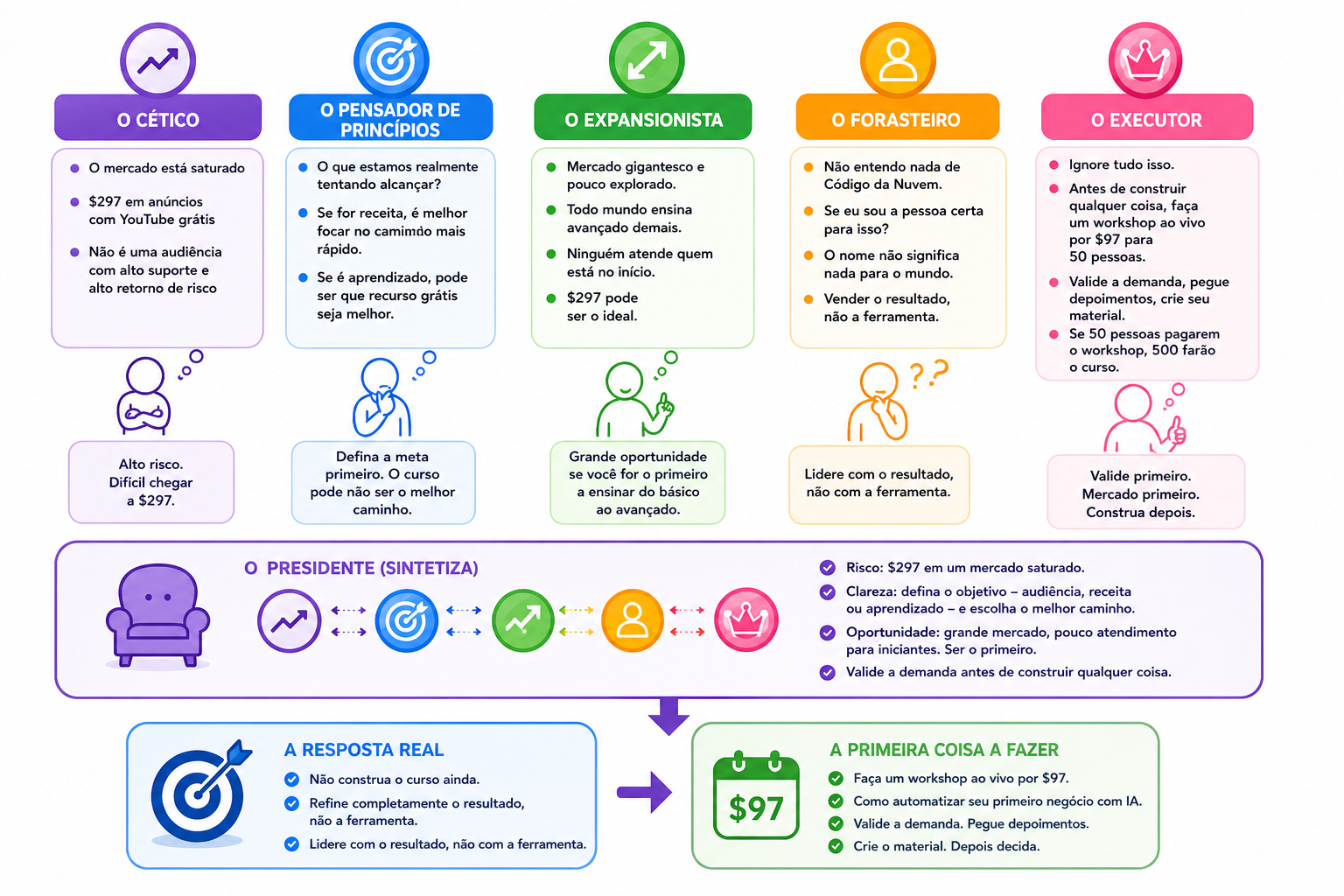
O Cético diz: o mercado tá lotado de curso de IA. R$ 997 compete com YouTube grátis. Público não-técnico significa muita dúvida no suporte e risco alto de pedido de reembolso. Quem está disposto a pagar R$ 997 provavelmente já passou da fase iniciante.
O Pensador de Princípios pergunta: o que você quer com isso, no fundo? Se é faturar, curso é um dos caminhos mais lentos. Se é construir autoridade, um conteúdo gratuito faz mais. Se é construir base de cliente pra ofertas mais caras depois, o preço e o público parecem desencaixados.
O Expansionista contra-ataca: empreendedor não-técnico aprendendo IA é um mercado gigantesco mal atendido. Todo mundo só ensina coisa avançada. Se você fincar bandeira no público iniciante, você é o ponto de entrada de toda essa cena. R$ 997 talvez seja baixo demais — com comunidade e mentoria isso vira programa de R$ 3.000.
O Forasteiro assopra: eu não sei o que é “Claude” nem “agente”. Se eu vejo “Curso de IA pra empreendedores” no Instagram, não sei se é pra mim. O nome não diz nada pra alguém de fora. Vende o resultado, não a ferramenta.
O Executor ignora todo o resto e diz: antes de gravar uma aula, roda uma oficina ao vivo de R$ 197 pra 50 pessoas. Valida demanda, ganha depoimentos, gera o material bruto do curso. Se 50 pessoas não pagam R$ 197 numa oficina, 500 não vão pagar R$ 997 num curso.
O Presidente lê tudo, incorpora as revisões cruzadas e devolve uma resposta direta: não construa o curso ainda. Reformule completamente o nome em torno do resultado que o aluno terá, não em torno da ferramenta. E a primeira coisa a fazer? Rodar uma oficina ao vivo de R$ 197 chamada “Como automatizar a primeira tarefa do seu negócio com IA”. Sem mencionar “Claude” nem “agente” no título. Validar primeiro. Depois decidir.
Cinco ângulos. Uma direção clara. Tudo numa sessão só.
Quando vale a pena (e quando não vale) usar o conselho
O conselho serve pra perguntas em que estar errado é caro. Onde existe incerteza real e o custo de uma decisão ruim é alto.
Boas perguntas pro conselho:
- “Devo lançar a R$ 197 ou R$ 597?”
- “Qual desses três posicionamentos é mais forte?”
- “Estou pensando em mudar de área, do X pro Y. Estou maluco?”
- “Aqui está o texto da minha página de venda. O que está fraco?”
- “Devo contratar alguém ou montar uma automação primeiro?”
Perguntas que não precisam de conselho:
- “Qual a capital da França?” — uma resposta certa, não precisa de cinco perspectivas.
- “Escreve um tweet pra mim” — tarefa criativa, não decisão.
- “Resume esse artigo” — processamento, não julgamento.
O conselho brilha quando há incerteza genuína. Se você já decidiu e só quer validação, ele provavelmente vai te dizer coisas que você não quer ouvir. Esse é exatamente o ponto.
Como instalar — Claude Code
Se você usa o Claude Code (a versão de terminal do Claude pra trabalhar com seus arquivos):
- Copia o conteúdo do
SKILL.mdque está no fim deste post (tem um bloco grande logo mais abaixo — copia inteiro). - Na pasta do seu projeto, crie a estrutura:
.claude/skills/llm-council/. Se você quer que a skill funcione em todos os seus projetos, use a pasta global no seu usuário:~/.claude/skills/llm-council/. - Dentro dessa pasta, salve o conteúdo num arquivo chamado exatamente
SKILL.md. - Abre o Claude Code na pasta do seu projeto e digita “council this” seguido de qualquer decisão real que você esteja matutando.
Pronto. A skill se ativa sozinha quando reconhece as frases-gatilho. Ela lê os arquivos de contexto que você já tem (CLAUDE.md, pastas de memória), então os conselheiros já entram em campo sabendo do seu negócio, do seu público, das suas restrições, antes de abrir a boca.
Como instalar — Codex
Se você usa o Codex (a CLI da OpenAI), funciona praticamente igual — o Codex também tem uma pasta de skills no mesmo formato:
- Mesmo conteúdo do
SKILL.mdque está mais abaixo. Copia tudo. - Na pasta do seu projeto, crie:
.codex/skills/llm-council/. Pra valer global, use~/.codex/skills/llm-council/. - Salve o conteúdo num arquivo
SKILL.mddentro dessa pasta. - Abre o Codex e dispara com “council this” + sua dúvida.
Detalhe útil: as frases-gatilho aceitam variações. “monta o conselho“, “pressiona essa decisão“, “não consigo decidir entre X e Y” — tudo aciona. Mas se quiser garantir, use “council this” — é a frase-gatilho oficial que funciona sempre.
Cada sessão gera dois arquivos pra você guardar
Toda vez que o conselho roda, você ganha de bônus na sua pasta:
- Um relatório visual em HTML, com o veredito do Presidente em destaque, onde os conselheiros concordaram, onde discordaram e qual o próximo passo. Bonito, fácil de bater o olho.
- Um transcrito completo em Markdown, com cada palavra de cada conselheiro, as revisões cruzadas, o raciocínio do Presidente. Pra quando você quiser destrinchar.
O arquivo SKILL.md (copia tudo daqui)
Aqui está o conteúdo completo. Clica no bloco abaixo pra abrir, seleciona tudo, copia, e cola num arquivo SKILL.md dentro da pasta de skills (Claude ou Codex).
Clique pra abrir o conteúdo do SKILL.md
---
name: llm-council
description: "Run any question, idea, or decision through a council of 5 AI advisors who independently analyze it, peer-review each other anonymously, and synthesize a final verdict. Based on Karpathy's LLM Council methodology. MANDATORY TRIGGERS: 'council this', 'run the council', 'war room this', 'pressure-test this', 'stress-test this', 'debate this'. STRONG TRIGGERS (use when combined with a real decision or tradeoff): 'should I X or Y', 'which option', 'what would you do', 'is this the right move', 'validate this', 'get multiple perspectives', 'I can't decide', 'I'm torn between'. Do NOT trigger on simple yes/no questions, factual lookups, or casual 'should I' without a meaningful tradeoff (e.g. 'should I use markdown' is not a council question). DO trigger when the user presents a genuine decision with stakes, multiple options, and context that suggests they want it pressure-tested from multiple angles."
---
# LLM Council
You ask one AI a question, you get one answer. That answer might be great. It might be mid. You have no way to tell because you only saw one perspective.
The council fixes this. It runs your question through 5 independent advisors, each thinking from a fundamentally different angle. Then they review each other's work. Then a chairman synthesizes everything into a final recommendation that tells you where the advisors agree, where they clash, and what you should actually do.
This is adapted from Andrej Karpathy's LLM Council. He dispatches queries to multiple models, has them peer-review each other anonymously, then a chairman produces the final answer. We do the same thing inside Claude using sub-agents with different thinking lenses instead of different models.
---
## when to run the council
The council is for questions where being wrong is expensive.
Good council questions:
- "Should I launch a $97 workshop or a $497 course?"
- "Which of these 3 positioning angles is strongest?"
- "I'm thinking of pivoting from X to Y. Am I crazy?"
- "Here's my landing page copy. What's weak?"
- "Should I hire a VA or build an automation first?"
Bad council questions:
- "What's the capital of France?" (one right answer, no need for perspectives)
- "Write me a tweet" (creation task, not a decision)
- "Summarize this article" (processing task, not judgment)
The council shines when there's genuine uncertainty and the cost of a bad call is high. If you already know the answer and just want validation, the council will likely tell you things you don't want to hear. That's the point.
---
## the five advisors
Each advisor thinks from a different angle. They're not job titles or personas. They're thinking styles that naturally create tension with each other.
### 1. The Contrarian
Actively looks for what's wrong, what's missing, what will fail. Assumes the idea has a fatal flaw and tries to find it. If everything looks solid, digs deeper. The Contrarian is not a pessimist. They're the friend who saves you from a bad deal by asking the questions you're avoiding.
### 2. The First Principles Thinker
Ignores the surface-level question and asks "what are we actually trying to solve here?" Strips away assumptions. Rebuilds the problem from the ground up. Sometimes the most valuable council output is the First Principles Thinker saying "you're asking the wrong question entirely."
### 3. The Expansionist
Looks for upside everyone else is missing. What could be bigger? What adjacent opportunity is hiding? What's being undervalued? The Expansionist doesn't care about risk (that's the Contrarian's job). They care about what happens if this works even better than expected.
### 4. The Outsider
Has zero context about you, your field, or your history. Responds purely to what's in front of them. This is the most underrated advisor. Experts develop blind spots. The Outsider catches the curse of knowledge: things that are obvious to you but confusing to everyone else.
### 5. The Executor
Only cares about one thing: can this actually be done, and what's the fastest path to doing it? Ignores theory, strategy, and big-picture thinking. The Executor looks at every idea through the lens of "OK but what do you do Monday morning?" If an idea sounds brilliant but has no clear first step, the Executor will say so.
**Why these five:** They create three natural tensions. Contrarian vs Expansionist (downside vs upside). First Principles vs Executor (rethink everything vs just do it). The Outsider sits in the middle keeping everyone honest by seeing what fresh eyes see.
---
## how a council session works
### step 1: frame the question (with context enrichment)
When the user says "council this" (or any trigger phrase), do two things before framing:
**A. Scan the workspace for context.** The user's question is often just the tip of the iceberg. Their Claude setup likely contains files that would dramatically improve the council's output. Before framing, quickly scan for and read any relevant context files:
- `CLAUDE.md` or `claude.md` in the project root or workspace (business context, preferences, constraints)
- Any `memory/` folder (audience profiles, voice docs, business details, past decisions)
- Any files the user explicitly referenced or attached
- Recent council transcripts in this folder (to avoid re-counciling the same ground)
- Any other context files that seem relevant to the specific question (e.g., if they're asking about pricing, look for revenue data, past launch results, audience research)
Use `Glob` and quick `Read` calls to find these. Don't spend more than 30 seconds on this. You're looking for the 2-3 files that would give advisors the context they need to give specific, grounded advice instead of generic takes.
**B. Frame the question.** Take the user's raw question AND the enriched context and reframe it as a clear, neutral prompt that all five advisors will receive. The framed question should include:
1. The core decision or question
2. Key context from the user's message
3. Key context from workspace files (business stage, audience, constraints, past results, relevant numbers)
4. What's at stake (why this decision matters)
Don't add your own opinion. Don't steer it. But DO make sure each advisor has enough context to give a specific, grounded answer rather than generic advice.
If the question is too vague ("council this: my business"), ask one clarifying question. Just one. Then proceed.
Save the framed question for the transcript.
### step 2: convene the council (5 sub-agents in parallel)
Spawn all 5 advisors simultaneously as sub-agents. Each gets:
1. Their advisor identity and thinking style (from the descriptions above)
2. The framed question
3. A clear instruction: respond independently. Do not hedge. Do not try to be balanced. Lean fully into your assigned perspective. If you see a fatal flaw, say it. If you see massive upside, say it. Your job is to represent your angle as strongly as possible. The synthesis comes later.
Each advisor should produce a response of 150-300 words. Long enough to be substantive, short enough to be scannable.
**Sub-agent prompt template:**
```
You are [Advisor Name] on an LLM Council.
Your thinking style: [advisor description from above]
A user has brought this question to the council:
---
[framed question]
---
Respond from your perspective. Be direct and specific. Don't hedge or try to be balanced. Lean fully into your assigned angle. The other advisors will cover the angles you're not covering.
Keep your response between 150-300 words. No preamble. Go straight into your analysis.
```
### step 3: peer review (5 sub-agents in parallel)
This is the step that makes the council more than just "ask 5 times." It's the core of Karpathy's insight.
Collect all 5 advisor responses. Anonymize them as Response A through E (randomize which advisor maps to which letter so there's no positional bias).
Spawn 5 new sub-agents, one for each advisor. Each reviewer sees all 5 anonymized responses and answers three questions:
1. Which response is the strongest and why? (pick one)
2. Which response has the biggest blind spot and what is it?
3. What did ALL responses miss that the council should consider?
**Reviewer prompt template:**
```
You are reviewing the outputs of an LLM Council. Five advisors independently answered this question:
---
[framed question]
---
Here are their anonymized responses:
**Response A:**
[response]
**Response B:**
[response]
**Response C:**
[response]
**Response D:**
[response]
**Response E:**
[response]
Answer these three questions. Be specific. Reference responses by letter.
1. Which response is the strongest? Why?
2. Which response has the biggest blind spot? What is it missing?
3. What did ALL five responses miss that the council should consider?
Keep your review under 200 words. Be direct.
```
### step 4: chairman synthesis
This is the final step. One agent gets everything: the original question, all 5 advisor responses (now de-anonymized so you can see which advisor said what), and all 5 peer reviews.
The chairman's job is to produce the final council output. It follows this structure:
**COUNCIL VERDICT**
1. **Where the council agrees** — the points that multiple advisors converged on independently. These are high-confidence signals.
2. **Where the council clashes** — the genuine disagreements. Don't smooth these over. Present both sides and explain why reasonable advisors disagree.
3. **Blind spots the council caught** — things that only emerged through the peer review round. Things individual advisors missed that other advisors flagged.
4. **The recommendation** — a clear, actionable recommendation. Not "it depends." Not "consider both sides." A real answer. The chairman can disagree with the majority if the reasoning supports it.
5. **The one thing you should do first** — a single concrete next step. Not a list of 10 things. One thing.
**Chairman prompt template:**
```
You are the Chairman of an LLM Council. Your job is to synthesize the work of 5 advisors and their peer reviews into a final verdict.
The question brought to the council:
---
[framed question]
---
ADVISOR RESPONSES:
**The Contrarian:**
[response]
**The First Principles Thinker:**
[response]
**The Expansionist:**
[response]
**The Outsider:**
[response]
**The Executor:**
[response]
PEER REVIEWS:
[all 5 peer reviews]
Produce the council verdict using this exact structure:
## Where the Council Agrees
[Points multiple advisors converged on independently. These are high-confidence signals.]
## Where the Council Clashes
[Genuine disagreements. Present both sides. Explain why reasonable advisors disagree.]
## Blind Spots the Council Caught
[Things that only emerged through peer review. Things individual advisors missed that others flagged.]
## The Recommendation
[A clear, direct recommendation. Not "it depends." A real answer with reasoning.]
## The One Thing to Do First
[A single concrete next step. Not a list. One thing.]
Be direct. Don't hedge. The whole point of the council is to give the user clarity they couldn't get from a single perspective.
```
### step 5: generate the council report
After the chairman synthesis is complete, generate a visual HTML report and save it to the user's workspace.
**File:** `council-report-[timestamp].html`
The report should be a single self-contained HTML file with inline CSS. Clean design, easy to scan. It should contain:
1. **The question** at the top
2. **The chairman's verdict** prominently displayed (this is what most people will read)
3. **An agreement/disagreement visual** — a simple visual showing which advisors aligned and which diverged. This could be a grid, a spectrum, or a simple breakdown showing advisor positions. Keep it clean and scannable.
4. **Collapsible sections** for each advisor's full response (collapsed by default so the page isn't overwhelming, but available if the user wants to dig in)
5. **Collapsible section** for the peer review highlights
6. **A footer** showing the timestamp and what was counciled
Use clean styling: white background, subtle borders, readable sans-serif font (system font stack), soft accent colors to distinguish advisor sections. Nothing flashy. It should look like a professional briefing document.
Open the HTML file after generating it so the user can see it immediately.
### step 6: save the full transcript
Save the complete council transcript as `council-transcript-[timestamp].md` in the same location. This includes:
- The original question
- The framed question
- All 5 advisor responses
- All 5 peer reviews (with anonymization mapping revealed)
- The chairman's full synthesis
This transcript is the artifact. If the user wants to run the council again on the same question after making changes, having the previous transcript lets them (or a future agent) see how the thinking evolved.
---
## output format
Every council session produces two files:
```
council-report-[timestamp].html    # visual report for scanning
council-transcript-[timestamp].md  # full transcript for reference
```
The user sees the HTML report. The transcript is there if they want to dig deeper or reference specific advisor arguments later.
---
## example: counciling a product decision
**User:** "Council this: I'm thinking of building a $297 course on Claude Code for beginners. My audience is mostly non-technical solopreneurs. Is this the right move?"
**The Contrarian:** "The market is flooded with Claude courses right now. At $297, you're competing with free YouTube content. Your audience is non-technical, which means high support burden and refund risk. The people who would pay $297 are likely already past beginner level..."
**The First Principles Thinker:** "What are you actually trying to achieve? If it's revenue, a course is one of the slowest paths. If it's authority, a free resource might do more. If it's building a customer base for higher-ticket offers, the price point and audience might be mismatched..."
**The Expansionist:** "Beginner Claude for solopreneurs is a massive underserved market. Everyone's teaching advanced stuff. If you nail the beginner angle, you own the entry point to this entire space. The $297 might be low. What if this became a $997 program with community access..."
**The Outsider:** "I don't know what Claude Code is. If I saw '$297 course on Claude Code for beginners,' I wouldn't know if this is for me. The name means nothing to someone outside your world. Your landing page needs to sell the outcome, not the tool..."
**The Executor:** "A full course takes 4-8 weeks to produce properly. Before building anything, run a live workshop at $97 to 50 people. You validate demand, generate testimonials, and create the raw material for the course. If 50 people don't buy the workshop, 500 won't buy the course..."
**Chairman's Verdict:**
*Where the council agrees:* The beginner solopreneur angle has real demand, but the current framing (Claude Code course) is too tool-specific and won't resonate with non-technical buyers.
*Where the council clashes:* Price. The Contrarian says $297 is too high given competition. The Expansionist says it's too low for the value. The resolution likely depends on how much support and community access is bundled.
*Blind spots caught:* The Outsider's point that "Claude Code" means nothing to the target buyer is the single most important insight. Every advisor except the Outsider assumed the audience already knows what this is.
*Recommendation:* Don't build the course yet. Validate with a lower-commitment offer first. But reframe entirely: sell the outcome (automate your business, get 10 hours back per week), not the tool.
*One thing to do first:* Run a $97 live workshop called "How to automate your first business task with AI" to 50 people. Don't mention Claude Code in the title.
---
## important notes
- **Always spawn all 5 advisors in parallel.** Sequential spawning wastes time and lets earlier responses bleed into later ones.
- **Always anonymize for peer review.** If reviewers know which advisor said what, they'll defer to certain thinking styles instead of evaluating on merit.
- **The chairman can disagree with the majority.** If 4 out of 5 advisors say "do it" but the reasoning of the 1 dissenter is strongest, the chairman should side with the dissenter and explain why.
- **Don't council trivial questions.** If the user asks something with one right answer, just answer it. The council is for genuine uncertainty where multiple perspectives add value.
- **The visual report matters.** Most users will scan the report, not read the full transcript. Make the HTML output clean and scannable.
Antes de você ir embora
Esse post-bônus saiu daqui especialmente pra quem acompanha o IATD. Se você ainda não recebe a nossa newsletter gratuita, é nela que solto coisas como essa antes de qualquer outro lugar — skills, prompts testados, atalhos, descobertas que economizam horas por semana — direto no seu e-mail, duas vezes por semana, sem encher a caixa.
Inscreva-se na newsletter aqui — é grátis, e os próximos bônus desse tipo vão sair só pra quem está na lista.
Se você instalar e rodar essa skill numa decisão real, me conta no Instagram (@ia.todo.dia) o que o conselho devolveu. Tô curioso pra ver onde ela vai pegar gente desprevenida.
Até a próxima.
— Sommer, Helena e um agente de IA.
Quer aplicar IA no seu trabalho?
Aprenda qual ferramenta usar para cada tarefa — ChatGPT, Claude, Copilot, Gemini e NotebookLM — nos cursos do IA Todo Dia.
Conhecer os cursos →